
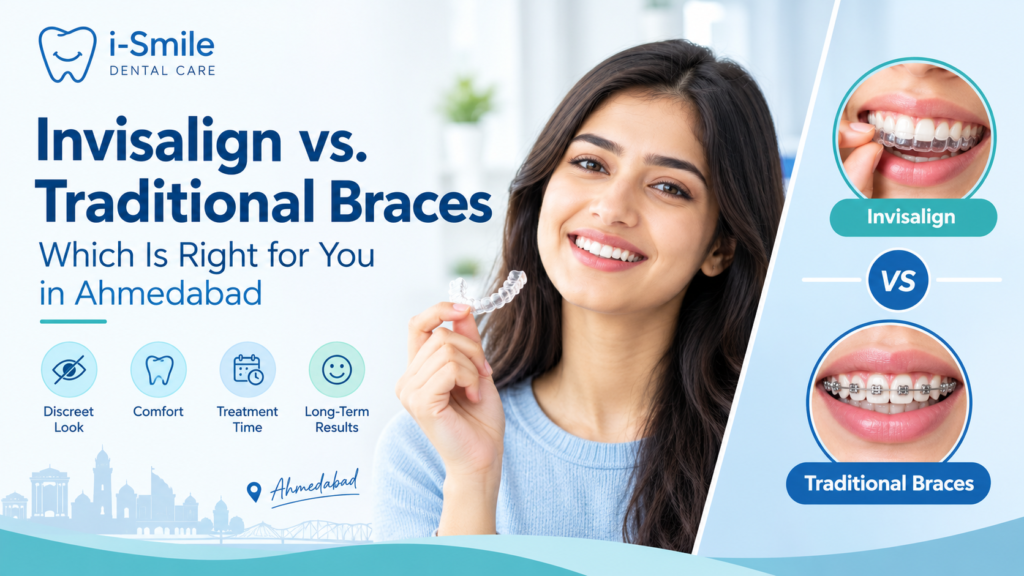
Straightening your teeth is one of the most rewarding investments you can make in your smile and your oral health. Today, patients in Ahmedabad can choose between two well-established options: traditional metal braces and clear aligners such as Invisalign. Both work, but they suit different cases, personalities and lifestyles. This guide compares them honestly so you can walk into your consultation with the right questions.
How Do Braces and Clear Aligners Work?
Traditional braces use small brackets bonded to the front of each tooth, joined by a thin archwire. The wire applies gentle, continuous pressure that moves the teeth into position, and the dentist adjusts it at regular visits. Because braces are fixed to the teeth, they work around the clock without any effort from you.
Clear aligners take a different route. You receive a series of custom-made, transparent plastic trays designed from digital scans of your teeth. Each tray moves your teeth a small distance, and you switch to the next one every week or two. The trays are removable, but they must be worn for roughly 20 to 22 hours a day to stay on schedule.
Appearance: Which Is Less Noticeable?
Aligners are nearly invisible, which is a major reason adults and working professionals choose them. Metal braces are visible, although modern brackets are smaller and more comfortable than older designs, and coloured elastics can even make them fun for teenagers.
Comfort and Daily Life
Braces can irritate the cheeks and lips for the first few days after fitting and after adjustments, and orthodontic wax helps in the meantime. Aligners have no wires or brackets, so they usually feel smoother, though you may notice pressure when you move to a new tray. In both cases the discomfort settles quickly.
Eating and Cleaning
With aligners, you remove the trays to eat and drink anything other than water, so there are no food restrictions. Brushing and flossing stay as easy as before, which makes it simpler to keep your gums healthy. With braces, sticky, hard and chewy foods such as caramel, nuts and whole apples can damage brackets, and cleaning around the wires takes extra time and special tools like interdental brushes.
Treatment Time and Suitability
The length of treatment depends far more on your case than on the type of appliance. Mild to moderate crowding, spacing and slight bite issues often respond very well to aligners. Complex problems such as severe crowding, large gaps, heavily rotated teeth or major bite corrections are often handled more predictably with braces. Most treatments take from several months to two years or more. Only a clinical examination, photographs and X-rays can tell you which approach will give the best result.
Quick Comparison
| Feature | Clear Aligners | Traditional Braces |
| Visibility | Nearly invisible | Visible brackets and wires |
| Removable | Yes, for eating and cleaning | No, fixed to the teeth |
| Food restrictions | None while trays are out | Avoid sticky and hard foods |
| Best suited for | Mild to moderate alignment issues | Mild to complex cases |
| Patient discipline | High, 20 to 22 hours daily wear | Low, works automatically |
Discipline Matters
Aligners only work if you wear them. Leaving them out for long periods delays progress and can compromise the final result. If you worry about consistency, or if the patient is a younger teenager, braces remove that risk because they cannot be taken off. Adults with a busy but organised routine usually adapt to aligners easily.
What About Cost?
The cost depends on the complexity of your case, the length of treatment and the type of appliance. Aligners are often priced higher than metal braces, but a proper consultation gives you a clear estimate based on your own teeth. The cheapest option is not always the best one, because careful planning and regular supervision matter far more than the appliance itself.
A Straighter Smile Is Part of a Bigger Picture
Orthodontic treatment often forms one step in a broader smile transformation. If you are also thinking about reshaping, whitening or other cosmetic improvements, read about the benefits of smile design to see how a planned approach can bring everything together.
How to Choose Between Aligners and Braces
Walk into your consultation with a few clear questions:
- Is my case mild, moderate or complex?
- How long is the treatment likely to take, and how many visits will I need?
- What happens if I lose or damage an aligner tray or a bracket?
- Which retainer will I need afterwards? Retainers are essential with either option, because teeth tend to drift back if they are not held in place.
At I Smile Dental Care, both braces and clear aligners are available, and the recommendation is based on your teeth, your goals and your lifestyle rather than on trends. Whichever route you take, the aim is the same: a healthy, well-aligned bite and a smile you are proud to show.
Ready to find out which option fits you? Book a consultation with I Smile Dental Care, and let a clinical assessment guide the decision.